Indexing
Keywords, subject terms, or index terms are known as ‘access points’ in EAD archival descriptions. When you include access points in your descriptions, you are increasing discoverability.
Access Points for the Archives Hub
Names, subjects and places connect descriptions. They bring archives together intellectually.
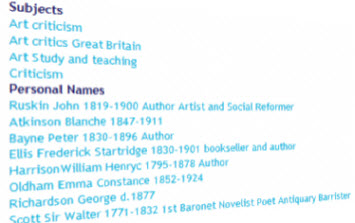
Access Points in the Archives Hub are all links to new searches, encouraging lateral discovery. They help to bring out connections between things.
Access Points show what a collection is significantly about.
Subject terms can be used to ensure that common search terms are covered. For example, a collection about women's rights may not include the word 'suffrage' in the description, but it may be an index term.
When a visitor looks at the description for one collection, the access points will send them to other collections that are also very relevant for related and sometime surprising themes.
Archives Hub Browse
Researchers can browse
Which Access Points?
You need to choose the most relevant Access Points for your collection description, highlighting some of the names and themes that are most likely to be of interest to researchers. We ask you to make sure that you always include an Access Point for the name of the person or organisation who created the archival material in your collection.
Controlled vocabulary
Access Points need to be created in a consistent way for the web links to work. To do this, we need you to use a recognized thesaurus or set of indexing rules, such as, Unesco Thesaurus and NCA Rules. This way, visitors will easily find other descriptions where the same Access Point has been included.
Help us point our visitors in the right direction – to your collection descriptions!