Chartism
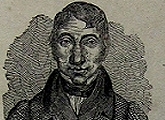
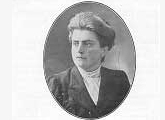
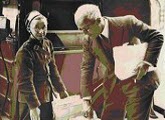
Images copyright © National Co-operative Archive. These are links
to larger images and additional information.
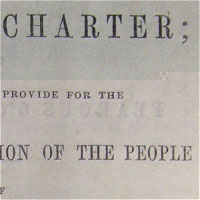
Chartism was a political and social movement in the United Kingdom that lasted approximately ten years from 1838-48. The name Chartism stems from the six point People's Charter that was drawn up in 1838. The movement grew from dissatisfaction with the 1832 Reform Act, which had failed to deliver the promise of an increased number of those who were eligible to vote.
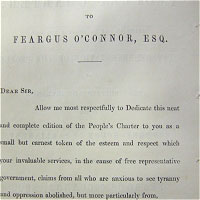
The movement, led by William Lovett, Henry Hetherington, John Cleave and later Feargus O’Connor stemmed from the setting up of the London Working Men’s Association, formed by Lovett in 1836. In 1838, a six point charter was drawn up listing their political demands. These were:
- Votes for all men over the age of 21
- Equal electoral districts
- Members of Parliament do not have to be property owners
- Payment for Members of Parliament
- Annual elections
- Secret ballot
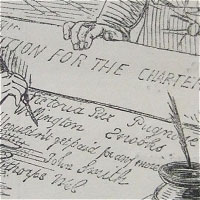
Towards the end of the 1830s, Chartism became more of a working class movement, rather than a movement of skilled artisans, and had spread throughout the country. By 1842, William Lovett had retired from politics and devoted his time to the education of the working class. In 1848, Feargus O’Connor led a mass meeting on Kennington Common, which would involve a public meeting and a procession on Parliament to present a petition. O’Connor alleged that there were over five million signatures on the petition when this figure was actually closer to one million, with many of this number being forgeries. This, along with O’Connor’s increasingly erratic behaviour, led to the demise of the movement by 1848
Descriptions for the papers of William Lovett, held at University of London Library can be seen on the Archives Hub, as can that for the papers of George Jacob Holyoake, a journalist and 'moral force' Chartist, held by the National Co-operative Archive.
This month the Hub highlights descriptions for the papers of other supporters of Chartism, and witnesses and opponents to the movement. There are also links to selected websites and a brief bibliography.
Collection descriptions
- Archibald Alison (1792-1867): baronet and lawyer involved in putting down disorder in association with Chartist unrest and strikes in 1837, 1842-43, 1848 and 1858.
- Thomas Allsop (1795-1880): silk trader, radical reformer, provided support for Irish Radical Feargus O'Connor (1796-1855)
- Lieutenant-General Thomas Marten (died 1868): commander of the Royal Dragoons, dealing with Chartist riots in Sheffield in 1839.
- George Jacob Holyoake (1817-1906): writer, journal editor and publisher, outspoken reformer, member of the Birmingham Chartists, and supporter of non-violent protest.
- William Lovett (1800-1877): co-author of Chartism: A New Organisation of the People, 1841.
- Henry Solly (1813-1903): Unitarian minister in Somerset; involved with the Chartist movement.
- Herbert Spencer (1820-1903): editor of The Pilot, the newspaper of the Chartist movement.
- Charles Bradlaugh (1833-1891): politician and freethinker ...
- George Howell (1833-1910): politician and writer; enrolled in a local Chartist group in Somerset in 1848
- Howell Ephemera Collection: George Howell collected material for his own research into the Victorian era, including documents relating to Chartism.
- Press cuttings: from 1848, reporting the speeches and trials of Chartists.
- Gustav Mayer (1871-1948): historian, author of The political history of the English labour movement from 1857-1872.
- James Garth Marshall (1902-1973): letters about Chartist unrest in Leeds and district, 1842
Related links
- Chartism and the Chartists in university archives: chartist.net news website.
- People's History Museum: correspondence, ephemera, political prints and cartoons, artefacts (Manchester)
- The Bishopsgate Institute:holds the papers of George Jacob Holyoake
- Working Class Movement Library: books, ephemera and artefacts (Salford)
- ChartistAncestors: lists many of those who particioated in the Chartist cause, with information drawn from newspapers, court records and books of the time.
- National Portrait Gallery: Thomas Attwood (three portraits), Feargus O'Connor (three portraits) and Robert Owen (five portraits) ...
- TheyWorkForYou.com: non-partisan, charity website for keeping in touch with our representatives in Parliament.
- e-petitions: create and sign petitions and deliver your petition directly to the Prime Minister (official Downing Street website)
- Unlock Democracy (incorporating Charter 88): advocates constitutional and electoral reform.
You can receive regular updates on our special features by joining our mailing list.