Dorothy Hodgkin
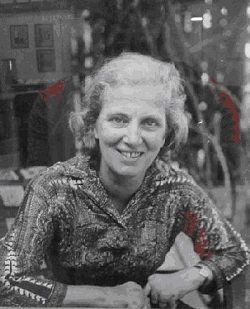
 The theme for this year's national Archive Awareness Campaign is 'Discovery: Archives in Science, Technology and Medicine', and we are celebrating the Nobel Prize-winning chemist and crystallographer Dorothy Crowfoot Hodgkin (1910–1994). Hodgkin's papers and correspondence are held by the Bodleian Library at the University of Oxford, where she carried out her pioneering research.
> collection descriptions > links > suggested reading
Born Dorothy Crowfoot, she developed an interest in chemistry and crystals while still at junior school, and carried out experiments at home in the attic. She went on to study chemistry at Oxford's Somerville College, one of the rare women science students there, and carried out her research in X-ray crystallography in the University's Natural History Museum.
After gaining a degree with first class honours, Hodgkin then went to Cambridge as a research student in the laboratory of physicist John Desmond Bernal. After completing her doctorate, she returned to Oxford as a Fellow of Somerville College and set up her own laboratory.
Penicillin had been discovered in 1929, and the onset of war brought urgent research into this antibiotic. Dorothy revealed its three-dimensional structure in 1944. This and much of her other work was published under the name Dorothy Crowfoot - although she married in 1937, Hodgkin still published under her maiden name until 1949.
After the war, Hodgkin helped form the International Union of Crystallography, of which she was President from 1972-1975. In 1956 she uncovered the structure of B12, a vitamin essential for blood formation.
In 1964 she was awarded the Nobel Prize for Chemistry, for the "determinations by X-ray techniques of the structures of important biochemical substances", making her the only British woman to date to receive a Nobel Prize for science. Hodgkin went on to determine the structure of insulin in 1969.
In 1970 she was elected Chancellor of the University of Bristol, normally a purely honorary position, but Hodgkin helped establish a scholarship for students from the developing world.
From the 1960s she attended the Pugwash Conferences on Science and World Affairs, and served as President from 1976-1988. Pugwash was founded in 1955 by Bertrand Russell, Albert Einstein, and others, with the aim of bringing together scientists from East and West to discuss disarmament.
Hodgkin was elected Fellow of the Royal Society (FRS) in 1947, and in 1965 she became only the second woman to be awarded the Order of Merit.
Sources: Georgina Ferry, "Hodgkin, Dorothy Mary Crowfoot (1910–1994), chemist and crystallographer", Oxford Dictionary of National Biography; Dr Tim Powell, Papers and Correspondence of Dorothy Crowfoot Hodgkin, 1910-1994.
Above, right: Dorothy Hodgkin in the Abbot's Kitchen adjacent to the Oxford Natural History Museum; photo Cipanlaknat, from Wikimedia Commons.
Collection descriptions
- Dorothy Hodgkin: papers and correspondence, photographs, slides and sound recordings
- William Bragg (1862-1942): Dorothy first read about X-ray crystallography in Bragg's Royal Institution Christmas lectures
- H. M. Powell (1906-1991): chemical crystallographer; Hodgkin was Powell's first research student at Oxford
- J. D. Bernal (1901-1971): physicist; Dorothy was a research student in Bernal's Cambridge laboratory
- Robert Robinson (1886-1975): winner of the Nobel Prize in Chemistry; Robinson helped Hodgkin obtain funding for her own laboratory
- D. C. Phillips (1924-1999): biophysicist, researcher in X-ray crystallography
- Rex Richards (born 1922): chemist and biophysicist; this collection includes correspondence with Dorothy
- Richard L. M. Synge (1914-1994): biochemist, winner of the Nobel Prize in Chemistry, 1952; this collection includes correspondence with Hodgkin
- University of Bristol: Dorothy was Chair of the University, 1970-1977
- Campaign for Nuclear Disarmament: Dorothy was a member of C.N.D.
- Pugwash Conferences: Dorothy attended the conferences from the 1960s, and was President, 1976-1988
Related websites
- Dorothy Crowfoot Hodgkin (1910-1994): obituary (University of Bristol website)
- Dorothy Crowfoot Hodgkin: obituary by life-long friend and Nobel laureate Max Perutz (1914-2002) (International Union of Crystallography website)
- Dorothy Crowfoot Hodgkin (Nobel Prize website)
- Dorothy Hodgkin (University of Oxford website)
- Pugwash Conferences on Science and World Affairs
- Campaign for Nuclear Disarmament
- Dorothy Hodgkin's model of pig insulin, c.1967 (Science Museum, London)
- British Science Association (formerly the British Association for the Advancement of Science); this September the Association's British Science Festival Better Lives Through Science will be taking place in Birmingham
- Oxford University Museum of Natural History
- Dorothy Hodgkin audio slideshow (BBC website)
- Dorothy Mary Crowfoot Hodgkin (1910-1994), Chemist and crystallographer: painting and photographs (National Portrait Gallery website)
- Royal Society Stamp Issue: Dorothy Hodgkin is one of 10 outstanding Fellows of the Royal Society commemorated in a new series of stamps (Royal Mail website)
- Dorothy Hodgkin / Biochemist: interview with Dorothy on video, 1990 (Web of Stories website)
Suggested reading
Links are provided to records on Copac for these items. Copac is the free, web based national union catalogue, containing the holdings of many of the major university and National Libraries in UK and Ireland plus a number of special libraries. For more information about accessing items see the FAQs on the Copac website.
- Dorothy Hodgkin: A Life by Georgina Ferry (2000) Records on Copac
- Out of the Shadows: Contributions of Twentieth-Century Women to Physics edited by Nina Byers and Gary Williams (2006) Records on Copac
- Dorothy Mary Crowfoot Hodgkin, O.M: a biographical memoir by Guy Dodson (2002) Records on Copac
- The Collected Works of Dorothy Crowfoot Hodgkin edited by G. Dodson and others (1994) Records on Copac
- Annals of Pugwash (annual conference publication) Records on Copac